Poker Bankroll Management: How Many Buy-Ins You Need
Poker bankroll management explained: buy-ins by stake, how your risk level sets your roll, risk of ruin, and when to move up or down. Focus keyword: poker bankroll management
Taylor Greene
Oct 23, 2026 · 13 min read · 5 views
Poker Bankroll Management: How Many Buy-Ins You Need
Poker bankroll management is the set of rules that decides which stakes you play, when you move up or down, and how much money you keep behind you to survive variance. Done well, it keeps one bad stretch from ending your poker career. This guide covers the standard buy-in numbers, how your own risk level should set them, how risk of ruin works, and where online poker rakeback fits into the plan.
No bankroll plan makes poker safe, and none guarantees a profit. Bankroll management only protects a player who already beats their games. What it gives you is a set of rules to follow when results turn bad, which is when most players make their worst decisions.
What Counts as Your Bankroll
Your bankroll is money you have set aside only for poker and can afford to lose completely. It is not the stack you sit down with, and it is not money for rent, bills or anything else that has a job to do.
A hobby player can dip into a regular wallet and be fine. Once poker gets serious, split the money. If you catch yourself topping up the roll with money you need, or depositing to win back a loss, stop and set firm deposit limits before you play again.
The unit used in the rest of this guide is the buy-in, or BI. In a cash game, one buy-in is the 100 big blinds you sit down with. At NL50, that is $50. In a tournament, it is the entry fee.
Bankroll Management Starts With Buy-Ins
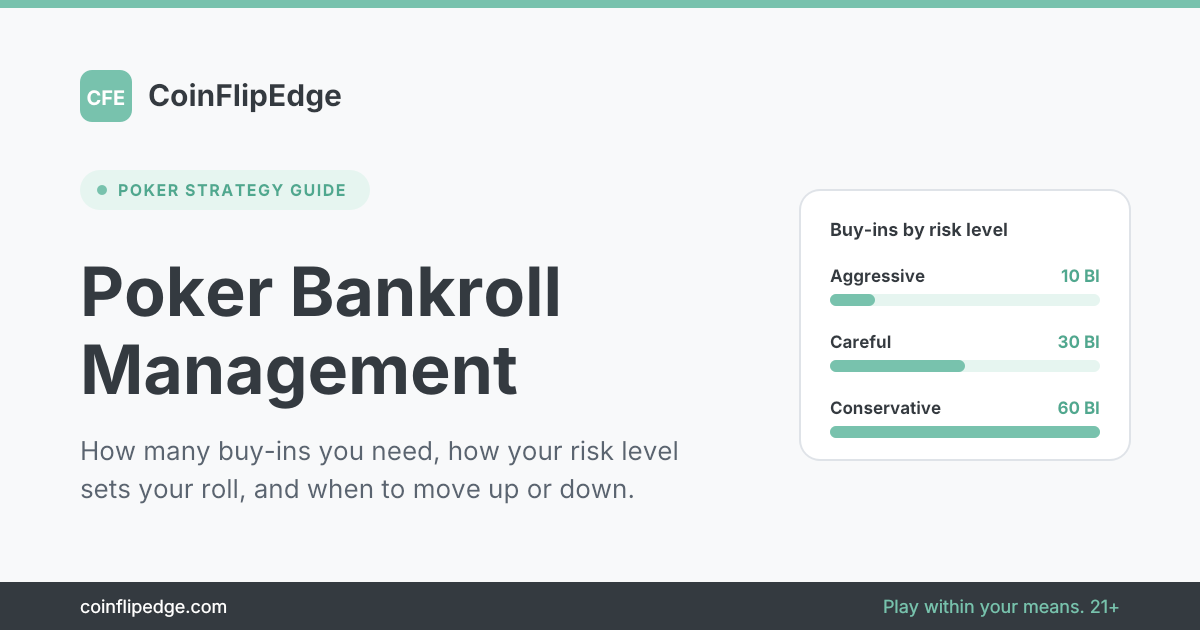
The table below shows the roll needed for No-Limit Hold'em cash games at three common risk levels. For a serious online player, 30 buy-ins is the usual starting point. Use the next section to pick your column instead of defaulting to the cheapest one.
| Stake | 1 buy-in | Aggressive (10 BI) | Careful (30 BI) | Conservative (60 BI) |
|---|---|---|---|---|
| NL2 | $2 | $20 | $60 | $120 |
| NL5 | $5 | $50 | $150 | $300 |
| NL10 | $10 | $100 | $300 | $600 |
| NL25 | $25 | $250 | $750 | $1,500 |
| NL50 | $50 | $500 | $1,500 | $3,000 |
| NL100 | $100 | $1,000 | $3,000 | $6,000 |
| NL200 | $200 | $2,000 | $6,000 | $12,000 |
Your Risk Level Sets Your Number
There is no single correct bankroll, because the right number depends on what a bust would cost you and how much swing you can stomach. Your risk level is the setting that turns those two things into a buy-in count.
- Aggressive: 10 buy-ins to play a level, 15 to move up. This is the fastest climb and the highest risk. Winning players commonly go through downswings of 10 to 20 buy-ins, so you will drop down often. It fits players who can reload without pain, have a proven winrate over a large sample, and will move down the moment the roll falls below 10.
- Careful: 30 buy-ins to play a level, 40 to move up. Progress is slower, but swings are survivable and you bounce between limits far less. This is the default for most serious players, especially anyone who is not sure they beat their level.
- Conservative: 60 buy-ins to play a level, 80 to move up. This suits players who withdraw regularly, rely on poker for income, play higher stakes, or have a thin winrate. Some players go to 100 buy-ins.
Five questions decide where you land:
- What does a bust cost you? If losing the roll means a reload from spare cash, you can run lighter. If it means missing a bill, you cannot.
- How sure are you of your winrate? A few thousand hands tell you almost nothing. Until you have tens of thousands, treat your winrate as a guess and lean toward more buy-ins.
- Do you withdraw? Every withdrawal shrinks your cushion. A player who cashes out each month carries more risk than the same player who reinvests, so build withdrawals into the plan.
- What format do you play? PLO, fast-fold, spin-style games and tournaments swing harder than standard hold'em cash games. See the format section below.
- How do you act in a downswing? If a bad week makes you jump stakes or reload to win it back, your real risk level is lower than you think. A conservative setup protects you from yourself.
Here is what that looks like in practice. Take three players who each have $1,500. The aggressive player holds 15 buy-ins at NL100 and plays it. The careful player holds 30 buy-ins at NL50. The conservative player holds 60 buy-ins at NL25. Same money, a fourfold gap in stakes. None of them is wrong. They answer different questions about what a bust costs.
Risk of Ruin: The Math Behind the Buy-In Rules
The buy-in counts above come from risk of ruin (RoR): the chance that a winning player still loses the entire bankroll at some point. Two numbers drive it, your winrate in bb/100 and your standard deviation (SD), also in bb/100. A widely used cash game approximation is:
RoR = e^(-2 × winrate × bankroll / SD²)
Enter the bankroll in big blinds, so 30 buy-ins is 3,000 bb. For a typical No-Limit Hold'em player with an SD of 100 bb/100:
| Bankroll | Risk of ruin at 5 bb/100 | Risk of ruin at 2 bb/100 |
|---|---|---|
| 10 buy-ins | about 37% | about 67% |
| 30 buy-ins | about 5% | about 30% |
| 60 buy-ins | about 0.25% | about 9% |
Read it two ways. First, with only 10 buy-ins even a solid winner busts more than a third of the time under these assumptions. Second, winrate matters as much as buy-ins: a 2 bb/100 player with 30 buy-ins still faces roughly a 30% chance of ruin.
The formula is a simplification. It assumes you play one stake forever, your winrate never changes and you never withdraw. Moving down after losses lowers your real risk, while withdrawals and an overestimated winrate raise it. Winrate is the number players get wrong most often, so when in doubt, plug in a lower figure than your tracker shows.
Where Online Poker Rakeback Fits In
Online poker rakeback returns part of the rake attributed to your play, and in bankroll terms it adds to your effective winrate. A higher winrate lowers your risk of ruin. As a hypothetical, not a deal term: if rakeback added 1.5 bb/100 to a 2 bb/100 winrate, the risk of ruin at 30 buy-ins would fall from about 30% to about 12%. At 10 buy-ins it would still be around 50%, so rakeback lowers risk but does not replace buy-ins.
It matters most at low stakes, where rake takes a bigger share of profit, and in most flat and progressive programs it keeps paying during a downswing because it follows volume rather than results. Scaled systems can adjust what counts based on how you play and win, so read the terms. To count it correctly in your plan:
- Count what is paid, not what is promised. Cash in your account counts. Points, tickets and unclaimed rewards count only at the value you can realistically use.
- Do not count it twice. Many trackers report winrate before rakeback, so add it once.
- Do not cut your buy-ins because of it. Treat it as extra protection.
You can compare current online poker rakeback deals and room details on our reviews page. If you play sweepstakes rooms, read our Clubs Poker sweepstakes review and Stake.us poker review first, and check each room's terms for how winnings are redeemed before you count any balance as bankroll.
Use a Bankroll Calculator
Patrick Howard's Mobius Poker bankroll calculator turns the ideas above into numbers for your own game. At the time of writing it is labeled beta, so treat its output as guidance. It is built for cash games and uses the Kelly criterion, adjusted for the fact that poker stakes come in fixed steps.
You enter whether you play online or live, your risk level (low, medium or high), bankroll, hands per month, winrate in bb/100 before rakeback, standard deviation, the lowest stake you will play, monthly withdrawals and your rakeback details. It returns a recommended starting stake, move-up and move-down points, a 12-month projection and your chance of busting.
Its risk level setting is the same dial this guide has been describing, so try all three and see how far your stake moves. Use a winrate you can defend from a large sample, and rerun it each month as your numbers change. A calculator only returns what you put in, so a flattering winrate produces a flattering plan.
Adjusting for Format
The buy-in numbers above are for standard hold'em cash games. These common rules of thumb cover the rest:
- Sit & Gos: 50 to 100 buy-ins, since payouts are spread across more finishers.
- Multi-table tournaments: at least 100 buy-ins, and often 150 to 200 for big fields and turbos, because most entrants do not cash. A common limit is no more than 1 to 2% of your bankroll in a single buy-in.
- PLO: closer equities mean more all-ins and bigger swings. Many players use 1.5 to 2 times their hold'em buy-ins, so about 50 to 60 for the careful profile.
- Fast-fold cash games: more hands per hour means faster swings, and winrates tend to be lower. Add roughly 20 to 30% to your normal cash game roll.
- Spin-style jackpot formats: the highest variance of the common formats, since much of the value sits in rare big multipliers. 100 buy-ins is the floor, and many regulars use 200 or more.
- Online versus live: online you see far more hands per hour, so carry a bigger cushion than you would live at the same stakes. Live games tend to be softer, so some players run slightly lighter there.
Moving Up, Shot Taking and Cashing Out
Move up only when you reach the next level's buy-in count for your profile, and move down the moment you fall below the minimum for your current one. Dropping down is where most plans fail, because it feels like admitting a loss. The rule exists so the decision is already made.
Shot taking, which means trying a stake above what your rules allow, can work if it stays rare and capped. Take shots no more than once every 10 to 20 sessions, cap each one at 5 to 10% of your bankroll, and set your stop point before you sit down. If the shot fails, go straight back to your old stake.
Cashing out needs rules too. Set milestones, withdraw part of the profit when the roll crosses them, and keep enough buy-ins behind you to stay protected. Panic reloads and stake jumps to chase losses are among the most expensive mistakes in poker.
Leaderboards and rake chases call for the same discipline. Check what a race counts and how prizes are paid, then treat it as a bonus on volume you had already planned. The CoinFlipEdge player leaderboard is one place to see how players rank. If a race is the reason you are sitting down, or the reason you are playing above your bankroll, it is costing you more than it pays.
Common Bankroll Mistakes
- Playing the stake you hope to win at instead of the stake your buy-ins allow.
- Counting rent or bill money as bankroll.
- Trusting a winrate from a small sample.
- Withdrawing without adjusting your plan.
- Counting unpaid rakeback, points or tickets as cash.
- Refusing to drop down after a downswing.
- Adding volume or moving up to hit a leaderboard or reward.
A Simple Bankroll Plan
- Separate your poker money from your living money.
- Pick your risk level using the five questions above.
- Choose your stake from the buy-in table.
- Enter your numbers in a bankroll calculator, using a cautious winrate.
- Add only the rakeback you have confirmed and actually receive. Our poker room reviews are a good place to compare terms.
- Write down your move-up, move-down and withdrawal rules before you play.
- Review your results every month.
FAQ
How many buy-ins do I need for online poker cash games? It depends on your risk level. Aggressive players use 10, careful players 30 and conservative players 60. For most serious players, 30 is the starting point.
What is risk of ruin? It is the probability that a winning player loses the whole bankroll at some point. It depends on your winrate, your standard deviation and your number of buy-ins.
Does online poker rakeback reduce the bankroll I need? It lowers your risk of ruin by raising your effective winrate, but it does not remove variance. Track it separately from your results and do not cut your buy-ins because of it.
Is there a bankroll calculator I can use? Yes. The Mobius Poker bankroll calculator lets you set a risk level and enter your withdrawals and rakeback details. Treat the result as an estimate.
How much bankroll do I need for tournaments? Much more than for cash games. Common guidance is at least 100 buy-ins for multi-table tournaments, often 150 to 200 for large fields, and no more than 1 to 2% of your bankroll in a single buy-in.
When should I move up in stakes? When your roll reaches the move-up number for your risk level, such as 40 buy-ins for the next stake under the careful profile, and not before.
Can I live off poker? Some high-volume players earn a large share of their income from poker, but no one can count on it. If you withdraw to cover living costs, use the conservative profile and include your withdrawals in the calculator.
Responsible Play
Poker involves risk, and you can lose money. You must be 21 or older, or the legal age where you live, to play. Bankroll management lowers the chance of a bust but cannot remove it, and it does not make poker a source of guaranteed income. Play within your means, set deposit limits, and take a break if you are chasing losses. If gambling is causing you problems, the National Problem Gambling Helpline offers free, confidential support at 1-800-GAMBLER (1-800-426-2537).
Affiliate Disclosure
CoinFlipEdge may earn a commission when you sign up for a poker room through links on our site, including the room pages linked in this article. This does not change the information we publish.
Final Thoughts
Pick your risk level first, size your roll to match it, move down when the numbers say so, and review them every month. For room reviews and current rakeback deals, visit CoinFlipEdge.
Written by
Taylor Greene