The Ultimate Guide to U.S. Online Poker in 2026: Legal Markets, Shared Liquidity & Sweepstakes Poker
Complete guide to U.S. online poker in 2026. Learn which states have legal real-money poker, how MSIGA shared liquidity works, and why sweepstakes poker sites like Clubs Poker and Stake.us are legal in most states. Covers the risks of club-based poker apps, how to vet offshore operators.

Disco Lime
Sep 24, 2026 · 18 min read · 1 views
The Ultimate Guide to U.S. Online Poker in 2026: Legal Markets, Shared Liquidity & Sweepstakes Poker
Online poker in the United States is at a turning point. For nearly two decades after the Unlawful Internet Gambling Enforcement Act (UIGEA) passed in 2006, American players navigated a confusing patchwork of state regulations, promotional alternatives, and unregulated venues while online poker boomed across Europe.
That momentum has shifted. Multi-state player pools, evolving interpretations of federal law, and the rapid growth of sweepstakes poker have changed how, where, and why Americans play online poker. Whether you grind cash games, chase big tournament guarantees, or simply want a safe place to play, this guide breaks down the legal landscape, the platforms worth your time, and how to protect your bankroll.
Key Takeaways
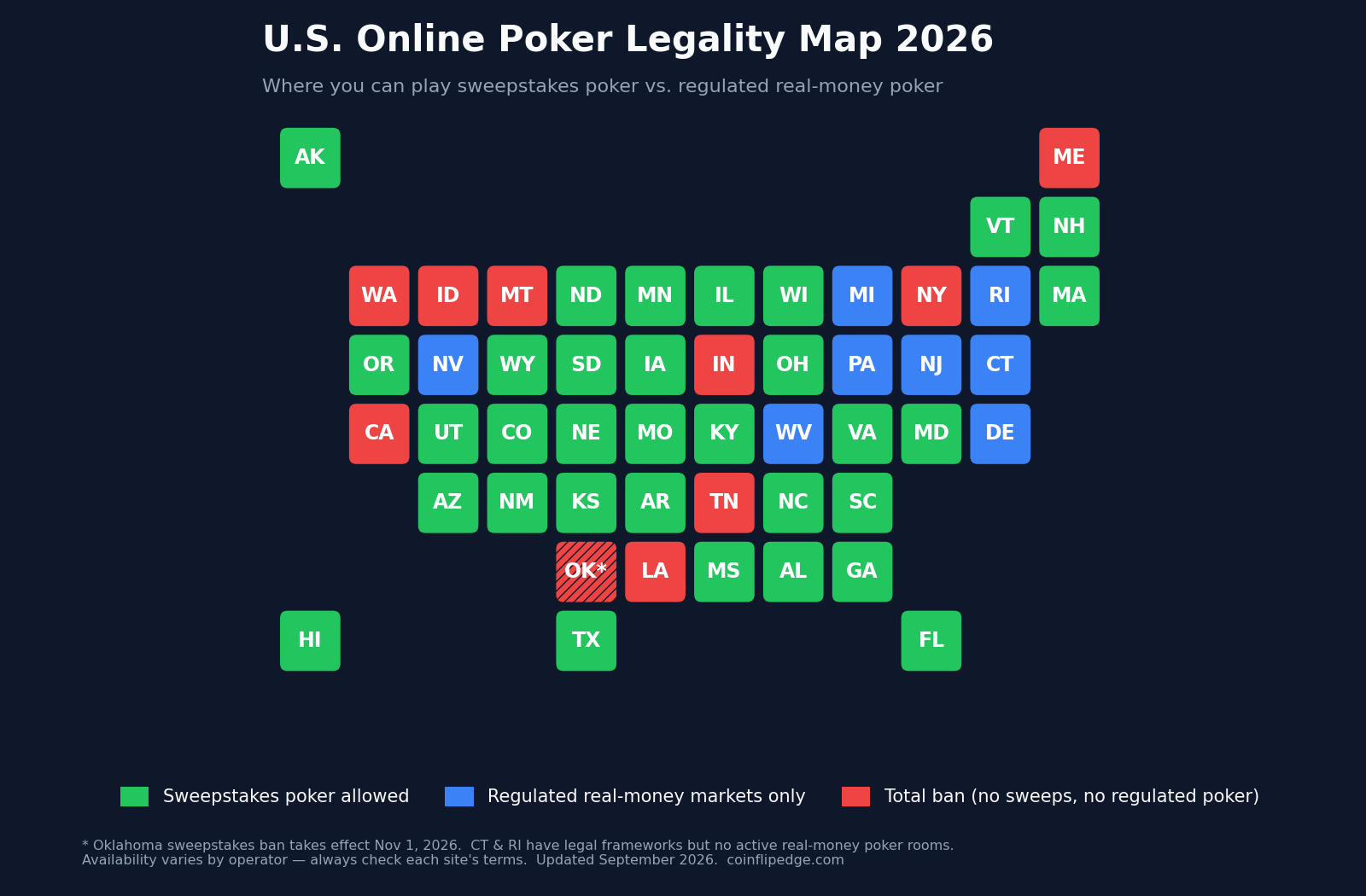
- State-by-State Patchwork: Real-money online poker is regulated and active in only a handful of states, including New Jersey, Nevada, Michigan, Pennsylvania, Delaware, and West Virginia.
- Shared Liquidity Engine: The Multi-State Internet Gaming Agreement (MSIGA) combines player pools across state lines for bigger cash game traffic and larger tournament guarantees.
- State Authority: Federal laws like the Wire Act and UIGEA shaped the market, but modern precedent leaves online poker regulation to individual states.
- Sweepstakes Poker Growth: In states without real-money options, sweepstakes poker sites like Clubs Poker and Stake.us operate legally using a dual-currency model.
- Due Diligence Matters: Always play on trusted, reviewed operators. That's why CoinFlipEdge only promotes sites we've vetted.
- Compliance Tech: Modern operators rely on automated KYC, geolocation, AML monitoring, and AI fraud detection to keep games fair.
The Legal Framework: Federal Law and the State Patchwork
To understand U.S. online poker today, you need to understand its history. Interstate wagering was historically restricted under the Wire Act of 1961, a federal statute written decades before the commercial internet. The real disruption came with UIGEA in 2006. UIGEA didn't outlaw individual players from playing online poker. Instead, it barred banks and payment processors from handling transactions for unregulated gambling operators.
Enforcement peaked on April 15, 2011, known across the poker world as "Black Friday." Federal indictments shut down the unregulated U.S. poker boom, froze player funds, and forced major operators out of the country.
U.S. Online Poker Legal Timeline
1961
Wire Act enacted — interstate wagering restricted federally
2006
UIGEA passed — banks barred from processing unregulated gambling funds
2011
Black Friday — DOJ shuts down unregulated U.S. poker rooms
2019+
State regulation era — courts reject broad Wire Act reading, MSIGA expands
Later in 2011, the Department of Justice issued an opinion clarifying that the Wire Act applied only to sports betting, opening the door for states to legalize online poker. The DOJ tried to reverse that stance in 2019, but federal courts rejected the broader interpretation, leaving state legislation as the defining authority for U.S. online gaming.
With no federal framework, state laws vary widely. Roughly eight states allow real-money online casino gaming, while more than thirty permit mobile sports betting. Real-money online poker sits in a narrower, highly regulated category.
States With Legal Real-Money Online Poker
- New Jersey — market leader and early shared liquidity adopter
- Nevada — focused primarily on WSOP cash games and tournaments
- Michigan — active regulated market with multi-state connectivity
- Pennsylvania — the largest individual state player pool
- Delaware — regulated market with shared liquidity links
- West Virginia — legislation passed, commercial operations still developing
Connecticut and Rhode Island have legal frameworks but no active real-money poker rooms, largely due to small population sizes. Major markets like California, Texas, and New York remain stuck in legislative debate, leaving millions of players without a state-licensed option.
Multi-State Shared Liquidity: Scaling Regulated Player Pools
Liquidity is the biggest challenge for any ring-fenced poker market. Unlike casino games or sportsbooks where you play against the house, poker is peer-to-peer. Tables need full seats, tournaments need thousands of entrants to support big guarantees, and cash games need to run 24/7 across multiple stakes.
When a state restricts its player pool to residents only, lobbies stay quiet, wait times grow, guarantees shrink, and players leave. The Multi-State Internet Gaming Agreement (MSIGA) solves this by letting licensed operators combine player pools across state lines. Delaware, Nevada, and New Jersey formed the original pact, and Michigan joined later to significantly boost traffic.
🏆 Bigger Tournament Guarantees
Combined multi-state fields let operators run flagship series with seven-figure prize pools that compete with international standards.
🕐 24/7 Cash Game Action
Interstate traffic keeps No-Limit Hold'em, Pot-Limit Omaha, and mixed-game tables running around the clock.
💰 Better Promotions
More network activity means more rake generated, which funds stronger bonuses, deposit matches, and rakeback programs.
🌍 European-Style Model
Merging state traffic mirrors the shared liquidity networks that already work across France, Spain, and Portugal.
The Rise of Sweepstakes Poker: Legal Access Across Most States
While regulated real-money poker expands slowly through state legislatures, millions of players outside those states still want competitive action. That demand has fueled explosive growth in sweepstakes poker.
Sweepstakes poker sites don't rely on real-money gaming licenses. They operate under U.S. promotional sweepstakes laws, making them available in most states where traditional online gambling isn't permitted.
| Feature | Regulated Real-Money Poker | Sweepstakes Poker |
|---|---|---|
| Legal Framework | State gaming commission licensing (PGCB, NJ DGE) | U.S. federal and state promotional sweepstakes laws |
| Availability | Licensed states only | 40+ states nationwide |
| Currency | Direct USD deposits | Gold Coins & Sweeps Coins |
| Wagering | Direct cash buy-ins | GC for fun, SC for prize-redeemable play |
| Prize Redemption | Withdrawals to bank or e-wallet | SC winnings redeemed for cash, gift cards, or crypto |
| Compliance | State iGaming rules, geolocation, full KYC | Age verification, KYC, mail-in entry options |
🎰 Gold Coins (GC)
Play-money tokens used strictly for entertainment. Gold Coins have zero monetary value and can't be transferred or redeemed for prizes.
💰 Sweeps Coins (SC)
Promotional entries that can't be bought directly. They come free with GC purchases, daily logins, or mail-in requests, and SC winnings can be redeemed for real cash prizes.
For players in Texas, Florida, California, and other large states, sweepstakes poker is a legal, compliant way to play competitive poker for real prizes. For a full breakdown, read our Ultimate US Sweepstakes Poker Guide.
Trusted Operators We Recommend
CoinFlipEdge reviews every site before we promote it. These are the operators we trust for U.S. players in 2026:
🥇 #1 Sweepstakes Pick
Clubs Poker
The best game selection in sweepstakes poker with over a dozen formats, and the only sweepstakes site offering mixed games. Modern software, soft recreational fields, and a US-based team.
🥈 #2 Sweepstakes Pick
Stake.us
One of the softest player pools in sweepstakes poker thanks to casino crossover traffic. Premium browser software, 3.5% automatic rakeback, and crypto prize redemptions.
✅ Trusted Operator
QQPoker
A trusted operator vetted by our team, with an exclusive CoinFlipEdge rakeback deal. Check our full review for game selection, traffic, and rakeback details.
Offshore Poker: Do Your Due Diligence
A large share of U.S. poker traffic plays on international sites licensed outside the United States. Many of these operators run reliable games and pay out consistently, but quality varies widely from site to site. The key is doing your due diligence and sticking with trusted operators.
Before depositing anywhere, check for:
- Payout track record: Consistent, on-time withdrawals over multiple years
- Game integrity: Active bot and collusion detection, plus certified RNG
- Transparent terms: Clear rake structures, rakeback, and bonus conditions
- Responsive support: Real people who resolve disputes quickly
- Player reputation: What regulars and the poker community say about the site
Why we review sites: CoinFlipEdge only promotes operators we trust. Every site we recommend has been vetted for payouts, game integrity, and player treatment, so you can play with confidence. Track how players are performing across our partner sites on the CoinFlipEdge Leaderboard.
The Risks of Club-Based App Poker
Club-based poker apps have become popular with U.S. players, but they carry real risks that most players don't consider. On apps built around the club model, such as PokerBros and ClubGG, the games are often run by independent club owners and agents rather than the app itself. That structure creates serious gaps in protection.
⚠️ No Fund Protection
Chips are often settled through club agents via peer-to-peer payment apps. If an agent or club disappears, your balance can go with them, with no operator or regulator to recover it.
📉 Liquidity Problems
Traffic is split across thousands of private clubs. When a club loses players or shuts down, games dry up overnight and cashouts can stall.
🔓 Inconsistent Security
Game integrity depends on individual club owners. Bot, collusion, and multi-accounting enforcement varies widely from club to club.
📄 No Paper Trail
Informal agent settlements leave little documentation, making it hard to prove balances, resolve disputes, or accurately report your winnings at tax time.
If you want a stable place to play, stick with established operators that hold your funds directly and have a proven payout history, like Clubs Poker, Stake.us, and QQPoker.
Technology, Security & Compliance in Modern Online Poker
Every legal hand of online poker in the U.S. runs on sophisticated technology. Regulators demand strict standards, pushing software providers to balance airtight security with a smooth player experience.
📍 Geolocation Enforcement
Wi-Fi triangulation, cell tower data, and IP tracking confirm players are inside approved states. VPN attempts get blocked instantly.
🪪 Automated KYC
Computer vision scans government IDs and verifies identity within seconds, stopping underage play and fraud while meeting AML requirements.
🤖 AI Fair Play Engines
Machine learning analyzes hand histories, decision timing, and betting patterns in real time to catch bots, collusion, and chip-dumping.
⚡ Uptime & Scale
Leading platforms host 10,000+ concurrent players with sub-second execution and verified RNG to handle peak tournament traffic.
What's Next: The Future of U.S. Online Poker
U.S. online poker is trending toward expansion, driven by commercial pressure and maturing technology. Four factors will shape the next few years:
Legislative Momentum
States with established mobile sportsbooks are natural candidates to add online poker for additional tax revenue.
MSIGA Expansion
More states joining shared liquidity means bigger fields and multi-million dollar guarantees.
Tribal Gaming Compacts
Tribes hold major influence in California and Oklahoma, and evolving compacts could route statewide online play through tribal servers.
Sweepstakes Growth
Until nationwide legislation arrives, sweepstakes poker will keep gaining share with better software, bigger schedules, and faster redemptions.
Longer term, U.S. networks may negotiate cross-border liquidity deals with mature European markets, which could spark a new global online poker boom.
Bottom line: U.S. online poker has moved past its fragmented history. Shared liquidity, legal sweepstakes models, and modern compliance technology give players more safe, competitive options than ever.
The smartest move is simple: play on trusted operators. Start with Clubs Poker, Stake.us, or QQPoker.
Frequently Asked Questions
Is online poker legal in the United States?
Yes, depending on your location. Real-money online poker is active in New Jersey, Nevada, Michigan, Pennsylvania, Delaware, and West Virginia. In most other states, you can legally play on sweepstakes poker sites like Clubs Poker and Stake.us.
How do sweepstakes poker sites work?
They use a dual-currency system. Gold Coins are for fun play, while Sweeps Coins are used in sweepstakes games where winnings can be redeemed for real cash prizes. Learn more in our sweepstakes poker guide.
What is MSIGA?
The Multi-State Internet Gaming Agreement lets regulated operators combine player pools across state lines, creating bigger prize pools, more traffic, and around-the-clock cash games.
How do I choose a safe poker site?
Check payout history, game integrity, transparent terms, and support quality. Or skip the legwork and use operators CoinFlipEdge has already reviewed and vetted.
Written by
Disco Lime